Wednesday, 14 December 2011

'Watching' Documentary on Film Openings


'Watching' explores the opening title sequences to films. So as an extra extension task as part of our research, the group has decided to watch this and make notes and answering questions from the handout provided by our media teacher. In order to increase our knowledge in  how we should make our own thriller opening and develop ideas that could be a success.

From viewing  the watching we have gathered the following information: When Thomas Sutcliffe says "Films need to seduce their audience into long term commitment. While there are many types of seduction, the temptation to go for instant arousal is almost irresistible."  He is trying to say that film makers  within the five minutes have to grab the attention of the audience in order for it to be a success and for the audience not to loose their interest .After all the audience are their to watch your film to love it and love you as a director so to achieve this you would have to play with their emotions and feelings. For example as soon as you are in the cinema watching a film, the magic begins, the lights turn of and the waiting crowd become your audience. And directors treasure this moment as this is what first grabs their interest in continuing to follow your line of work and the film in hand.  To add sam fuller also says that if the first page of your script doesn't get the audience engaged then throw it away. As grabbing the audience in the first five minutes is most important.  A great sedative film opening is 'Psycho.'  Its the beginning of it what  makes the shower so different so it raises curiosity.

According to Director Jean Jacques Beinieix, the risks of 'instant arousal' are that if you have a very strong opening that arouses the audience, you then have to maintain that same level because as a director you open yourself to questions such as "what next?" and you have to answer. And the key risk is in not answering the question. Which is the problem in making films.  For example Jean Jacques had a fight with his producers because they wanted a directive novel to be just simple, casual and nothing complicated. Jean wanted to start it of the an opera a "diva" singing. And they said that starting the first three minutes with an opera, he was committing suicide. Which off course Jean disagreed.


"A good beginning must make the audience feel that it doesn't know nearly enough yet, and at the same time make sure that it doesn't know too little." This is because the beginning of the film is where it establishes; characters, story and tone. And the audience are then making out what it represents and triggers there emotions. It helps them identify what they should feel, weather it makes them laugh, take it serious and what the nature of the film is. It wants to let us know how to watch the film as it follows. And the whole purpose is to get the the audience into the directors wave length.Once this is achieved you are able to do what you want and they will follow.  For example in patrice langue film ridicule, it makes the audience feel it started without us and is already in a rush to an appointment and makes us feel that we have to scurry in order to find out more and catch up even though we know the character is going to what seems an argent appointment. So this is a perfect example of where in beginning the audience knows what is happening but are lured in to know more.As if they new from the start the relationship between the director and  his audience breaks down.


Critic Stanley Kauffmann describes the classic opening as to be a film opening with a establishing of New York city, usually seen from the east. leading to a close up to a building which then the camera went up the building to a window and going inside the window where it went pass the receptionist desk to the prier office where "karry Grant."  As a result this has told us where it was taking place, what the occupation of the hero was and most importantly what the organisation of the world was. It works because it leads the audience to the audience smoothly, telling them what the nature and kind of the story it is. But they to expect what's coming. A good example of this is the opening of The Last Picture Show where the picture fades into a small movie theatre into a long slow plan through the street.


Kyle cooper's title sequence to the film seven is effective because it tuned the audience to the right pitch.The title sequence came part of the first scene of the film, it tells a story and introduces us to the obsessive nature of the film and characters. It also foreshadows what will happen. The sykotic energy was so successful it influenced the whole of the film.


Orsen wells wanted to plunged the audience into his story without giving the audience time to prepare themselves through his opening to the film A touch of Evil, he did this by intentionally excluding the scene of credits and title music . Universal studios however more cautious, they didn't understand the opening shot or the picture it self. Therefore in the final cut they had put a "nice score" underneath it including credits also source music, as a result the effect was lost. Thus why Orsen wrote a memo of 58 pages pleading to take it of. Despite this the studio proceeding in the editing and because of this "they blunted his originality." 


The term "a favourite trick of Film Noir" is where your actually putting the ending in beginning of the film.  for example the casino starts of  with an  ending. The trick is  looking ahead to what is to come.


The opening of the film The Shining creates suspense through; the up left of the helicopter shot, and the camera following the car in the second scene "like a predator." High up and from behind. This is telling us that the characters are travelling in the wrong direction.

Shot by Shot remake - Collateral (2004) - Final Product


Friday, 9 December 2011

Shot by Shot remake - Collateral (2004) - Editing Process

After the shooting session, we made our way back to the college. We began transferring all the clips from the memory card to our hard drive. We will be using the Final Cut Pro program to edit and put together our shots. Below there are a few photos of what we were doing in the lesson.


Hannah going through the clips.
Sorting out what clips we will be using.
Putting the clips together.

Shot by Shot remake - Collateral (2004) - On Shoot Pictures

Here are some photos that were taken whilst recording our Shot by Shot remake, we was filming just outside Angel Station.


Thursday, 8 December 2011

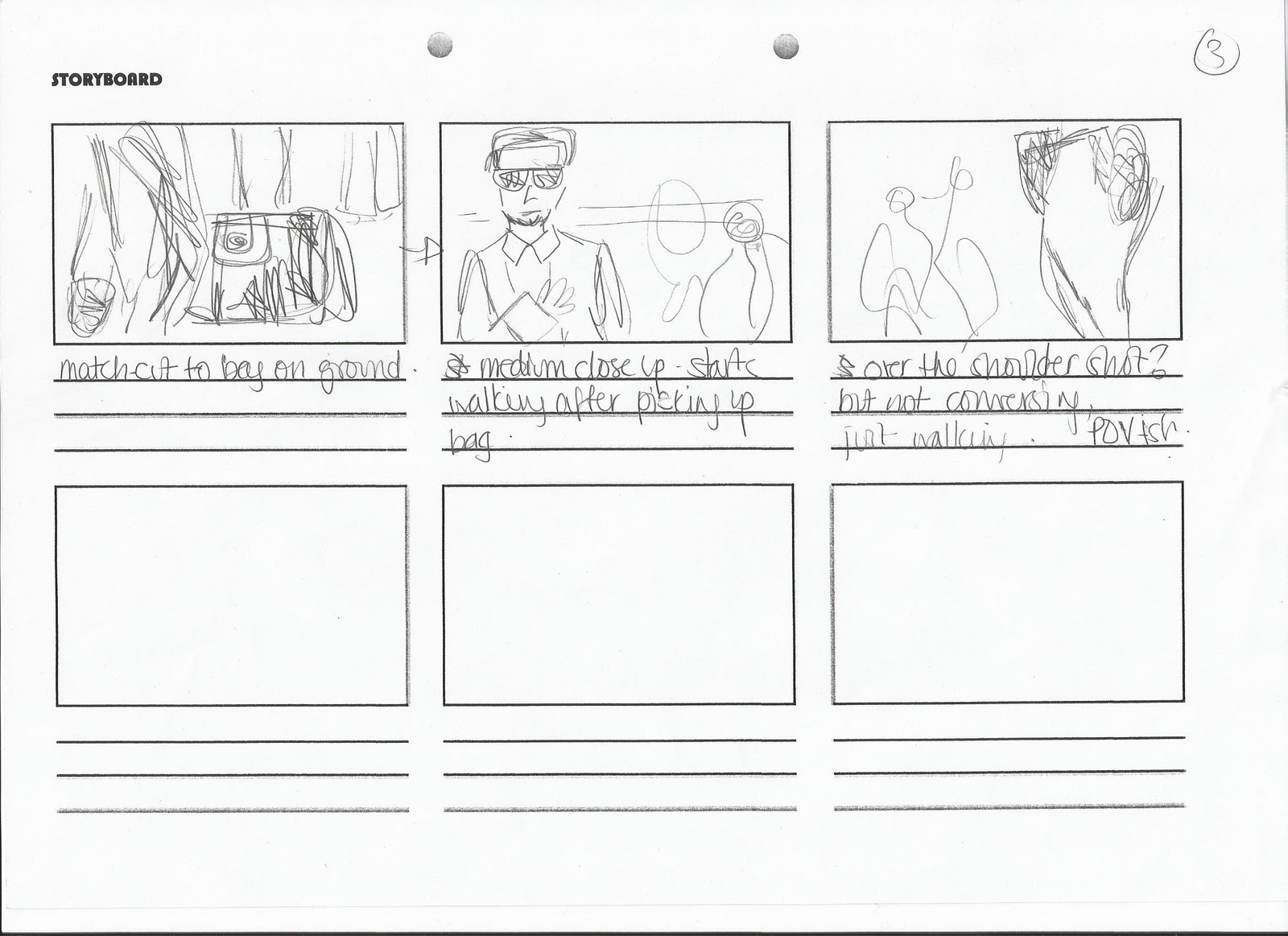
Shot by Shot remake - Collateral (2004) - Storyboard


Storyboard


Health and Safety Tutorial

During the Health and Safety tutorial we were introduced the equipment that we will be using to film our film opening. We will be using professional JVC Camcorders, the other filming equipment we were introduced to also consists of; a Tripod, Memory card and Camera Battery. We learnt how to inject and eject the memory card in correct way, how to place and remover the battery, how to open up the tripod fully and making sure it is secure and lastly how to place the camcorder onto the tripod in the correct way and making sure it is locked so the camera do not move around. We also learnt what some of the buttons on the camcorder are and how they function.

JVC Camcorders
Battery
Memory Card
Inserting the Battery
Inserting the memory card
Tripod
When opening and close the tripod we have to make sure all the tabs are closed so that it is secured and will not move about.
Showing how to place the camcorder securely onto the tripod. Once we have slid the camcorder through the top of the tripod, we will here a click, this tells us that the camera is safe, however me must also make sure to turn the lock, so the camcorder stays in place and does not slide about. To remover the camcorder we hold down the red button on the side, and at the same time slide the camcorder out.

Friday, 2 December 2011

Introduction to Cameras - First filming practice

Big close up

Medium close up

Wide shot of an area
Tried to shoot feet in an interesting way

Another close up of Hannah's face

Medium close up of Hannah taken by the stairs where there were lots of natural light shining onto her face therefore we can see Hannah clearly, whereas if was was to take the shot with Hannah in front of the window, we will not see her as clearly.

Conventions of Film Openings

Our first introduction to this project was opened up by understanding what  a film opening is, as sometimes we could mistake it for things like trailers.And to be able to create a film opening you have to know what it is and how it works. 

So through having a look at examples of film openings and following a discussion. We identified that these are the following conventions: A film opening is all about seducing the audience into continuing to watch the film in hand. A film opening should establish the characters and genre (presenting the characters so early in the film is to point out stereotypes t for example the "house wife" or "hero" or "vilan.") 
Directors can choose to do this in so many ways for example: A flashback, panning of landscape, Narrations, chase scene, fight/shoot out scene, title sequence.Which would be either in slow or fast paste which sets the mode, tone, genre for example slow pasting would suggest danger or it makes the audience almost spy like following and have a nose around. It is also alluring.  These are also known as classic openings.   
Significantly all film openings have an opening  of establishing shots or blank screen with titles and lists of credits to directors, actors, casting e.t.c .

Production and distribution logos (of the main companies that work on a film)- these logos are essential as logos can reflect the story line of the film and gives it characterisation. For example Warner Bros  is a representation of a shield that looks worn out. (It could emphases on its history of how long its been around) 
Collaborating with the company ident's is music which is a key asset because we associate the music with those idents and audiences would then automatically remember who it is and where it comes from. This then helps to create a big commercial for the companies so that the audiences are familiar with these names and would prefer them and would be keen in watching other films they make.


Conventions of Film Openings - Skyline


Distribution Ident

Credits?


Establishing Shots


 Film Title

Introduction to Main Character

Conventions of Film Openings - Black Swan


 Distribution Ident

Featured Actors Credit


Film Title

Itroduction of Main Character